


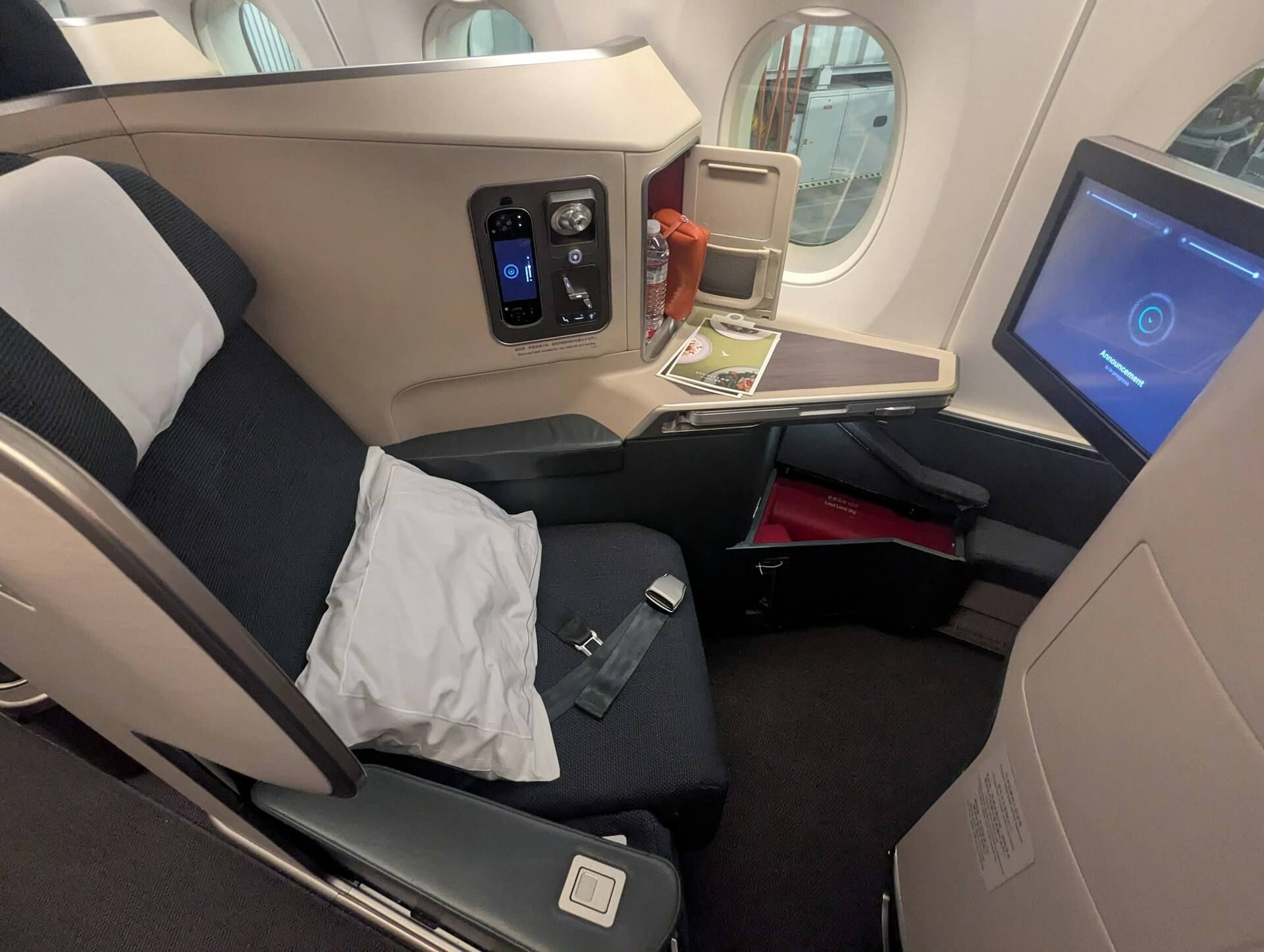

Not all business class is created equal. Plenty of travelers book expecting a lie-flat bed and a good night's sleep, then board a narrowbody jet with a recliner that tilts back 140 degrees. Same ticket class. Completely different product.
On one end, Singapore Airlines, Qatar Airways, and Cathay Pacific operate widebody aircraft on long-haul routes with private suites and beds over six feet long. On the other, intra-European "business class" can mean a standard economy seat with the middle blocked. The aircraft type drives most of this variation, and knowing the difference before you book is the whole game.
Lufthansa is the clearest example. For years, the airline ran a 2-2-2 business class on many long-haul routes, meaning window passengers had no direct aisle access. Then came Allegris, introduced in 2024 on the Airbus A350-900. That configuration carries 38 business class seats in a 1-2-1 layout, including eight suites with sliding privacy doors. Beds extend up to 2.20 meters on specific "Extra Long Bed" seats. Source: Lufthansa Allegris product page.
Book without checking the aircraft and you might get the A350 Allegris. You might get an older 747-8 still awaiting its retrofit. The airline brand on your ticket tells you almost nothing. The aircraft type tells you what you're actually buying.
Direct aisle access means stepping from your seat into the aisle without climbing over anyone. In a 1-2-1 configuration, every seat has it. In a 2-2-2 layout, window seats don't. On a 14-hour overnight flight, that distinction matters enormously. I've arrived exhausted from a "business class" seat simply because I avoided the restroom to not disturb a sleeping seatmate.
True lie-flat means a 180-degree horizontal surface, parallel to the floor. Angled flat slopes downward, putting your feet lower than your head. Frequent flyers consistently report meaningfully better sleep quality on genuine lie-flat seats compared to angled or reclined positions.
Features worth evaluating before any business class booking:
Award bookings are harder to change than cash tickets. Availability windows are narrow, fees apply on many programs, and the routing you redeemed for may not exist on an alternative date. Burning a large points balance on a recliner you thought would be lie-flat doesn't just cost you the experience. It costs you the redemption entirely.
Widebody aircraft have two aisles and are built for long-haul international routes. Narrowbody aircraft have a single aisle, used primarily on short- and medium-haul flying. The cabin width difference directly determines what's possible in a business class seat design. Once you can read an aircraft code and know whether to feel confident or cautious, every other step gets faster.
The Airbus A320 family dominates intra-European flying, where "business class" typically means a 3-3 economy layout with the middle seat blocked. The Boeing 737 variants work the same way on regional routes. Neither aircraft type offers a genuine lie-flat product. If you're redeeming points within Europe expecting a flat bed, verify the aircraft first.
The Airbus A380, a double-deck widebody, carries business class on both decks on airlines like Emirates and Qantas. Upper deck business class is generally preferred for a quieter, more private feel. The aircraft is large enough that cabin products vary significantly by carrier and configuration.
The Boeing 777-300ER warrants special attention. It remains one of the most widely operated long-haul jets in the world, but flies in both 2-2-2 and 1-2-1 configurations across different carriers and even within the same airline's fleet. Always verify the 777-300ER configuration specifically.
Aircraft | Type | Typical Business Layout | Lie-Flat | Key Watch-Out |
|---|---|---|---|---|
Airbus A350-900/1000 | Wide-body | 1-2-1 | Yes | Varies by carrier; check for suite doors |
Boeing 777-300ER | Wide-body | 1-2-1 or 2-2-2 | Usually | Configuration varies widely by airline |
Boeing 787-8/9/10 | Wide-body | 1-2-1 | Yes | Older 787s may have dated products |
Airbus A380 | Wide-body (double-deck) | 1-2-1 | Yes | Upper deck business class preferred |
Airbus A330-300 | Wide-body | 2-2-2 or 1-2-1 | Usually | Older configs may lack direct aisle access |
Airbus A321/A321XLR | Narrowbody | 1-1 | Sometimes | Best narrowbody product; confirm lie-flat |
Boeing 737 variants | Narrowbody | 2-2 | No | Recliner only; regional routes |
Airbus A320 family | Narrowbody | 3-3 | No | Intra-Europe "business" often blocked middle |
No single tool gives you the complete picture. The real approach is triangulation: multiple sources cross-referenced until you have enough confidence to book.
Airlines restrict seat map access for real business reasons. Paid seat assignment revenue depends on limiting early visibility. Operational flexibility requires reassigning seats for weight and balance without triggering complaints. And on routes where the airline runs a less competitive aircraft cabin, limiting comparison shopping reduces booking abandonment. Third-party tools exist to restore that information balance.
Go to seatguru.com, enter your airline, flight date, and flight number, then click "Find" and "View Map." If you don't have a flight number yet, search by departure and arrival cities. SeatGuru covers more than 175 airlines and nearly 1,300 aircraft configurations globally. Source: SeatGuru About page.
Color coding does most of the work. Green seats are good, yellow means caution, red indicates a problem. Hover over any seat for specific notes: legroom measurements, reclining limitations, proximity to lavatories, power port availability.
SeatGuru's known limitation: it sometimes lags behind airline reconfigurations. An airline retrofits a cabin, SeatGuru's data hasn't caught up, and you're looking at an outdated map. Always cross-reference with at least one additional source.
Once SeatGuru has given me the baseline, I go to aerolopa.com for a second opinion. Aerolopa's most useful capability is configuration data tied to individual aircraft within a fleet. Different jets wearing the same livery can carry meaningfully different cabin products, particularly when an airline is mid-retrofit. I've used Aerolopa to catch a recently updated cabin that SeatGuru still listed under the old layout. The seat count discrepancy was the signal I needed to dig further.
On Google Flights, the aircraft type appears in the flight details panel when you expand any result. On FlightAware and FlightRadar24, entering a flight number shows the aircraft currently assigned. During the airline's own booking flow, look for a field labeled "Equipment" or "Aircraft." For any high-value redemption over 50,000 points, call the airline directly to confirm the assignment and have it noted in your booking record.
Seat maps tell you the layout. Reviews tell you whether the product delivers. I use AirlineRatings.com for structured ratings, Skytrax for passenger feedback volume, and specialist blogs including The Points Guy and One Mile at a Time for photographed cabin walkthroughs.
One rule without exception: only reviews from the past 12 to 18 months are reliable unless fleet data confirms no cabin changes. Airlines update catering, replace IFE systems, and refurbish cabins without press releases.
YouTube trip reports are the highest-fidelity format available. Watching someone walk through the exact cabin, open the suite door, and lie flat in the bed eliminates nearly all remaining uncertainty. Search the airline name, aircraft type, and cabin class together, then filter for videos from the past 12 months.
Start with Google Flights. Enter your route and date, expand the flight details panel, and look for the aircraft type listed there. It appears as a manufacturer and model name: "Boeing 777-300ER" or "Airbus A350-900." If it's not visible, open the airline's booking flow and look for the "Equipment" field. For confirmed assignments, FlightAware and FlightRadar24 both let you enter a flight number to see the scheduled aircraft.
Once you have the aircraft type, go to SeatGuru and pull the seat map for that specific airline and aircraft. The map is always oriented forward. Each square represents one seat. Vertical gaps running the length of the map are aisles.
The most useful shortcut for reading a business class seat map: if you see more than two columns of seats sitting directly side by side in the business cabin, window seats almost certainly lack direct aisle access. A 1-2-1 layout shows four columns with gaps between each pair. A 2-2-2 layout shows six columns grouped in pairs, meaning window seats are separated from the aisle by a middle seat.
Configuration | Aircraft Example | Seat Letters | Notes |
|---|---|---|---|
Narrowbody 3-3 | Boeing 737 | A-B-C / D-E-F | A and F are windows; C and D are aisles |
Widebody 2-4-2 | Boeing 767 | A-B / C-D-E-F / G-H | A and H are windows |
Business 1-2-1 | Airbus A350 | A / D-G / K | A and K are windows with direct aisle access |
Business 2-2-2 | Older 777 | A-B / D-E / G-H | A and H are windows; B and G lack aisle access |
Airlines skip the letter "I" universally in seat assignments because it resembles the numeral "1." So on a widebody with window seats at A and K, there's no "I" seat between H and J.
Blocked seats: A blocked airline seat appears gray or unavailable even when the flight isn't full. Airlines hold seats for elite frequent flyer allocations, crew use, exit row verification, and paid upgrade inventory. Many blocked seats release at T-24 hours when online check-in opens. Check the seat map at that exact moment. The airline's mobile app often shows real-time availability more accurately than the website.
My personal hierarchy for any overnight flight over eight hours:
The lie-flat versus angled flat distinction is the one airlines blur most in their marketing. "Fully flat" and "lie-flat" are sometimes used interchangeably, but they can mean very different things. Verify the angle before you book.
On a 12-hour overnight flight from London to Singapore, I once booked a business class window seat in a 2-2-2 configuration. My seatmate fell asleep within an hour of takeoff. I spent the next 11 hours rationing bathroom visits and arrived more tired than I should have been. That experience permanently changed how I evaluate seat configurations.
Privacy is the second differentiator. Qatar QSuites represent the current benchmark: a fully enclosed suite with a door and a double bed option for traveling pairs. Not every business class product needs to reach that standard, but knowing where your specific aircraft cabin sits on the privacy spectrum matters before you board.
Once the aircraft type, seat configuration, and seat type are confirmed, do one final check: recent reviews of that specific product on that specific airline. Use AirlineRatings.com, Skytrax, and specialist blogs. Watch a YouTube trip report for the exact cabin. Ten minutes of video research eliminates more uncertainty than any written description.
Aircraft swaps happen. Airlines change equipment assignments for maintenance, operational efficiency, and fleet rebalancing. I've arrived at the airport expecting a QSuites-equipped 777 and found a reconfigured aircraft with an older business class product. I noticed the seat map change 72 hours out, which gave me enough time to call the airline and negotiate a solution. Most travelers never check their booking again after purchase.
ExpertFlyer offers the most reliable Aircraft Change Alerts. Enter your airport pair, date, airline, and flight number, and you'll receive a notification if the equipment changes. Free membership includes real-time seat map access and one seat alert. The full alert suite requires a paid subscription, but for any high-value business class redemption, it's worth it.
For free monitoring: save your flight on Google Flights for schedule change notifications, and check the seat map manually on the airline app at T-90 days and again at T-72 hours. Compare both to your booking-day screenshot. If the available seats have changed layout or rows have appeared or disappeared, that's an immediate red flag. Call the airline before other affected passengers do.
When an aircraft swap negatively affects your booked business class cabin, here's the action plan:
Swap Scenario | Your Rights | Recommended Action |
|---|---|---|
Business to economy downgrade | 30-75% fare refund (US DOT / UK261) | Request refund or rebooking immediately |
Better seat to worse seat, same cabin | Paid seat-fee refund only | Request seat fee refund; consider rebooking |
QSuites to standard business | No cash right; goodwill only | Ask for date change under informal policy |
Schedule change over 3 hours | Rebooking or full refund | Request alternative routing |
Almost never. Most airlines explicitly reserve the right to swap equipment without liability in their contracts of carriage, provided no cabin class downgrade occurs. Qatar Airways has an informal goodwill practice where passengers affected by a QSuites aircraft swap may receive one free date change within 21 days, but only on tickets issued on Qatar stock (ticket numbers beginning with 157) and operated exclusively by Qatar Airways. Bookings through partner airlines are not eligible. Always ask. Never assume.
There's a particular kind of confidence that comes from boarding a long-haul flight knowing exactly what's waiting for you. You know the suite has a door. You know the bed goes fully flat. You know your seat has direct aisle access. That confidence is entirely achievable, and it costs nothing but 20 minutes of research.
The first time you work through all five steps, it might take 30 minutes. By the third booking, it'll take 15. After that, it becomes instinct. You'll glance at an aircraft code during a search and immediately know whether to feel excited or cautious before you've even clicked through.
The next time you're searching for a business class flight, try step one. Look up the aircraft type. Pull the seat map. See what you find. That single habit, applied consistently, will change the quality of every premium cabin experience you have from this point forward.
FAQ
Open Google Flights, search your route and date, and expand the flight details panel. The aircraft type appears there for most flights. Alternatively, check the airline's booking flow for an "Equipment" field, or enter your flight number into FlightAware or FlightRadar24. For high-value redemptions, call the airline directly to confirm.
Blog